
Chania
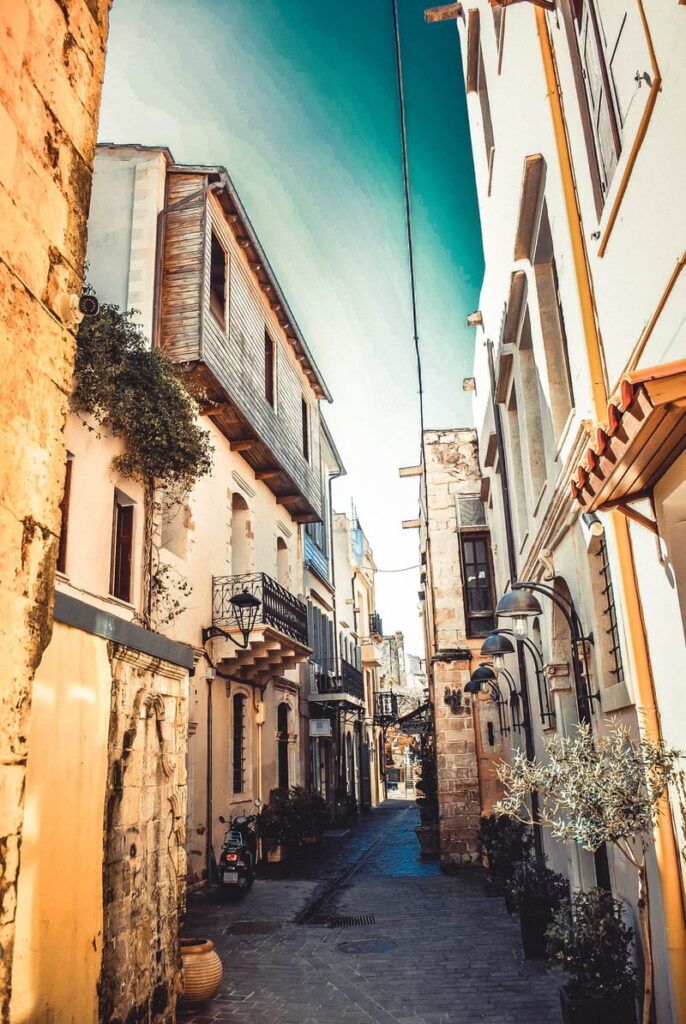
Touristic town, Romantic old harbor Maze streets. Venetian atmosphere
The city is divided in two parts ; the old town and modern town.The old town is surrounding the old harbor, from where the urban area was developped. Venetian fortifications were added to the old town from in 1538, but only the western and eastern parts are still there. The south part was destroyed and the new town was developped.
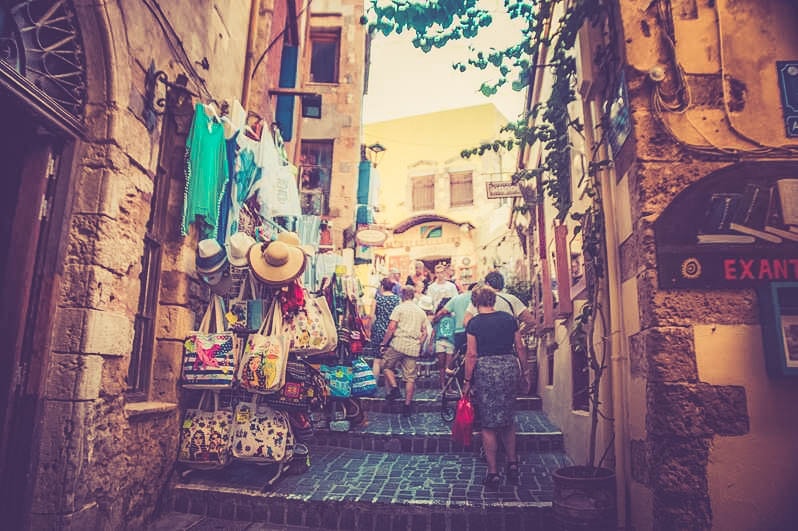
Kastelli
Kastelli : inhabited since neolithic, Kasteli is the central part of old town. Kasteli, meaning castle, was set on a hill, next to the sea, providing a secure position for a settlement and its inhabitants. it has been fortified by walls that surrounded the citadel from the very Hellenistic Times. This is evidenced by the remains of the Hellenistic walls (3rd century BC) found beneath the wall remain. During the Ottoman rule, the prominent Turks live in Kasteli. The Venetian Cathedral of Virgin Mary converted into a mosque, as was done in many other buildings of the city, In 1898, the “Great Powers” of that time, (France, Italy, Russian empire and United Kingdom) decide the international occupation of the island. In kasteli, a neoclassical architecture building housed the headquarters of the Great Powers. Today it houses the offices of the rectorate of the Technical University of Crete
Syntrivani
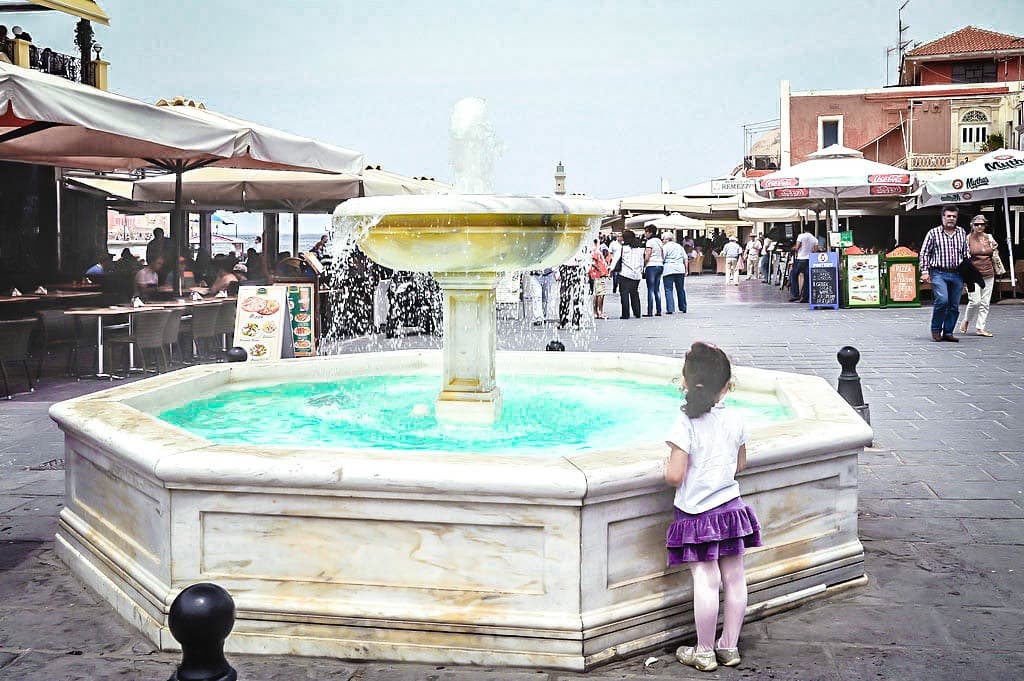
(from Turkish şadırvan ‘fountain’. It’s the main square of the old town, also known as Eleftherios Venizelos Square, . It is the heart of the touristic activities in the area. Encircled by cafes, restaurants and several other shops, the square is very popular on week ends and during celebration days, where locals go for coffee,ice cream, restaurants,…
Topana
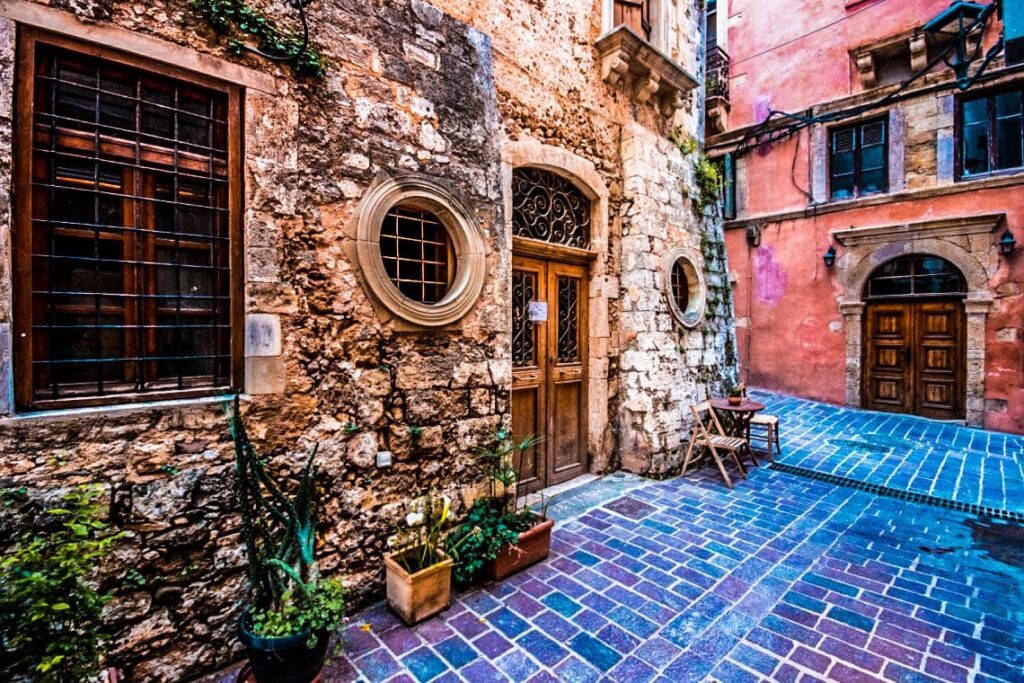
Set on the west side, Topana was the Christian quarter during the Ottoman period. Its name comes from the Venetian ammunition warehouse (Turkish tophane), Venetian ammunition warehouse, which is still preserved at the end of Theotokopoulou street. The fortress of Firkas that was built by the Venetians at the north end of Topanas, right next to the entrance of the harbor of Chania, is converted into barracks, while later in the 19th century it is used as a prison. many of historical buildings with Venetian, Turkish or European architecture, were renewed and ar are operating either as hotels or as shops, cafes and restaurants. This make topana area a very beautifull place to stroll in the small alleys and historical streets
Evraiki
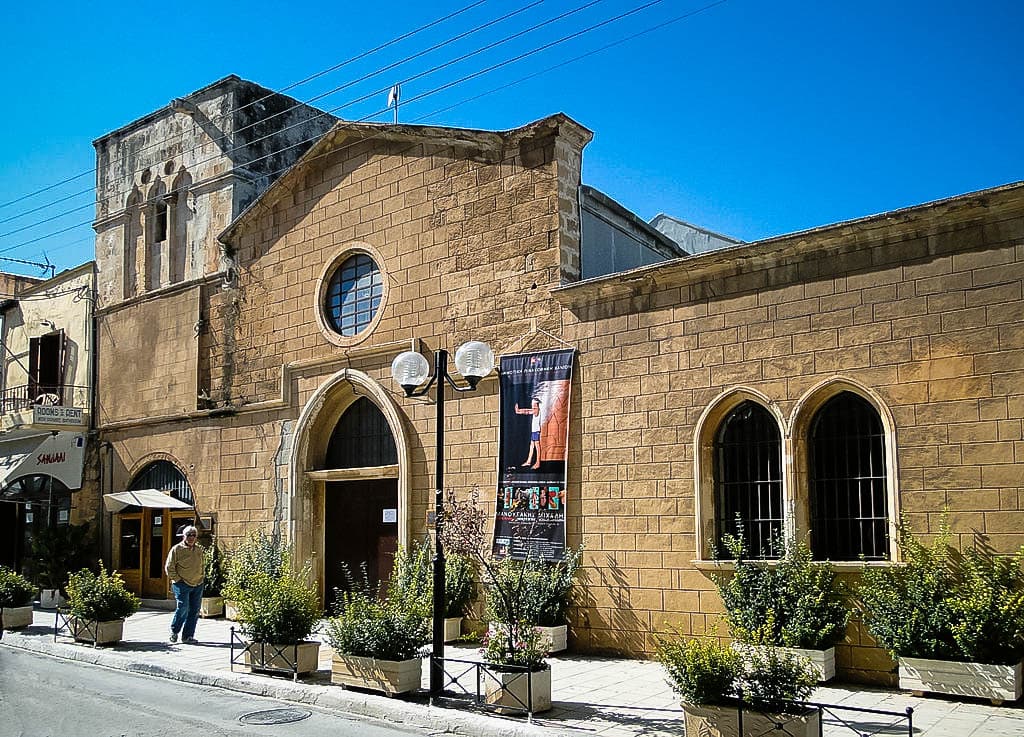
Located at the north-west part of old town, was the Jewish quarter (Evraiki or Ovraiki) , behind the harbour and within the borders of Topanas. Main street of the Jewish quarter was the Kondilaki street that starts at the harbour and extends to the south, up to the southern walls of Chania old town, where lies the circular bastion of Lando. there were two synagogues built in the Jewish quarter of Chania. One was completely destroyed by the bombardment of the city of Chania by the german luftwaffe aircrafts in World War II, and the other one abandoned when the Jewish community dissolved in 1944. Very few Jewish people escaped the Nazis. Those who captured were sent on the SS Tanais, a greek cargo boat requisitioned by the German occupation forces., to concentration Auschitz. On 9 June 1944, the boat was torpedoed by a Royal Navy submarine and sunk off the port of Heraklion, Crete, killing several hundreds of deported Cretan Jews. In the mid-1990s, the Jewish synagogue of Etz Hayyim, in Kondaki street,, was restored and since then is in a use.
Book your flight to Chania
Modern town
The modern part of Chania is where most locals live and work. It is less traditional than the old town, but there are still areas of some historical interest. The oldest district of the modern city is Nea Hora (meaning “New Town”) and is from early 18th century .. During the same era the district of Halepa began to grow to the east of the city and used to be home for the local aristocracy. Other historical buildings in the area include Eleftherios Venizelos’s House (built 1876-1880), the old French school (now property of the Technical University of Crete, housing the Department of Architecture), the Church of Agia Magdalini (built 1901-1903), The “Palace” (built 1882, house of Prince George during the period of the Cretan independence) and The Church of Evangelistria (built 1908–1923). Part of the marine area of Halepa is called Tabakaria, where a unique architectural complex of old leather processing houses is situated The district of Koum Kapi (the Venetians had first named it “Sabbionara”, which means “the Gate of the Sand”, the same as “Koum Kapi”) situated beyond the walls at the eastern part of the old town, was also one of the first places to be inhabited outside the fortification walls. Initially, it was home for the “Halikoutes”, a group of Bedouins from North Africa who had settled there in the last years of Ottoman rule. Nowadays it is a developing area with many cafes, bars and restaurants on its beach. The 1913 indoor market (“Agora”), is on the edge of the old town and is popular with tourists and locals alike.
History of Chania
Chania is the site of the Minoan settlement called Kydonia, (meaning quince in greek). Its name appeared on Linear B as ku-do-ni-ja. Cydonia was one of the five great cities of Minoan Crete, although exact location of the ancient city was not even resolved until the latter half of the 20th century. Cydonia was the most powerful centre of western Crete and producing Bronze Age pottery and was one of the first cities of Europe to mint coinage. Cydonia was established as a Neolithic settlement in the fourth millennium BC, as archaeological excavations in the old town of present day Chania have revealed . The city reemerged after the end of the Minoan period as an important city-state in Classical Greece, one whose domain extended from Chania Bay to the feet of the White Mountains. The first major wave of settlers from mainland Greece was by the Dorian Greeks who came around 1100 BC. Kydonia was constantly at war with other Cretan city-states such as Aptera, Phalasarna and Polyrrinia and was important enough for the Kydonians to be mentioned in Homer‘s Odyssey (xix.200). In 69 BC, the Roman consul Caecilius Metellus defeated the Cretans and conquered Kydonia to which he granted the privileges of an independent city-state. Kydonia reserved the right to mint its own coins until the 3rd century AD
Byzantine times
The early Christian period under Byzantine rule and the rule of the Arabs, who called the settlement Al Hanim (“the Inn”), are not well documented. Under the Arabs, the Christian population was persecuted and moved to the mountains. The Byzantine Empire retook the city in 961 AD . In this period the Arabic name of the city was changed into Greek Chania. Byzantines began to strongly fortify the city in order to prevent another Arab invasion, using materials from the ancient buildings of the area.
Venetian period
Ottoman times
During the opening months of the Cretan War (1645–1669) the city’s walls did not prevent an Ottoman army from capturing it from the Venetians after a two-month siege. Many Cretans fled to escape persecution, many others were slaughtered or converted to Islam, while numerous Turkish Muslim settlers arrived .
Muslims resided mainly in the eastern quarters, Kastelli and Splantzia, where they converted the Dominican church of St Nicholas into the central Sovereign’s Mosque (Turkish: Hünkar Camısı). They also built new mosques such as the Küçük Hasan Pasha Mosque or Yali Mosque on the harbour. Hamam (public bats) , and fountains were a feature of the Ottoman city. the headquarters of the Turkish Governor of Crete, is installed in Chania, at the northern end of the kasteli hill, in a government complex building called “The Konaki,” that housed the home of Pasha, prisons, as well as living space for the guards.
The city remained under Ottoman control despite fighting during the Greek War of Independence (1821-29), the Cretan Revolt (1866–1869) and the Cretan Revolt (1878). Due to the island’s mixture of Muslim and Christian residents, Crete was the subject of international debate between the European great powers, most notably at the Treaty of Berlin (1878) which resulted in the Pact of Halepa.