
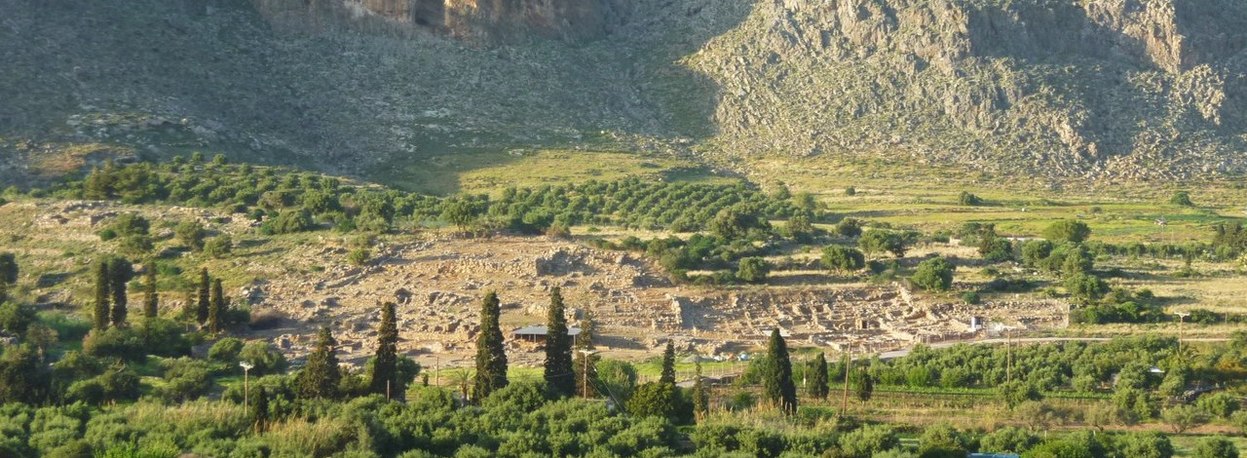
The smallest of minoan palaces
The Palace of Zakros, the most remote of the Minoan palaces, is situated on the eastern coast of Crete, to the south of Palaikastro. This strategic location offers natural protection from the fierce north winds that sweep past Cape Sidero, at the northeastern tip of the island. As the last of the significant palatial sites to be unearthed, Zakros is notably smaller than the more renowned palaces of Knossos, Malia, and Phaistos. The initial excavations were carried out by D.G. Howarth from the British School of Archaeology in Athens. During this phase, twelve houses in the vicinity of the palace were discovered, a significant revelation as their existence had previously gone unnoticed. However, this early excavation effort was eventually halted. In 1961, Nikolaos Platon took the reins to continue the work, revealing an intact palace that had avoided looting prior to its destruction. Ongoing excavations continue to this day, marking Zakros as one of the most critical archaeological sites for Minoan studies since the Second World War. The chronological proximity of its discovery has facilitated the application of modern and scientifically rigorous excavation methods, setting it apart from the earlier explorations of other Minoan palaces.
eastern gate
The Palace of Zakros likely served as the Minoan gateway to the east, a theory supported by various movable artifacts found at the site, indicating connections with the Middle East. Notable discoveries in the West Wing include an elephant tusk and six ox-hide ingots, alongside Canaanite jars unearthed near the well. Similar to other Minoan palaces, Zakros underwent reconstruction following the destructive earthquakes that impacted earlier structures. The second iteration of the palace was erected around 1600 BCE and met its demise around 1450 BCE, coinciding with the decline of several Minoan centers in Crete. Fortunately, many artifacts remained in their original contexts, likely due to the abrupt nature of the destruction. The palace itself spanned 8,000 square meters, comprised 150 rooms, and featured a Central Court measuring approximately 30 meters by 12 meters, which is significantly smaller than that of the more renowned Knossos.
North Wing
Both the town and the harbor were situated to the north of the palace at Zakros, likely connected by a road. The main entrance to the palace complex was through the northeast entrance (LXIX), which led directly into a large northeast court (LXIII) that provided access to the Central Court. **Zakros: The Central Court** The positioning of the main entrance in the northeast, adjacent to the sea, suggests that Zakros may have served primarily as a trading center rather than an agricultural one, despite the presence of fertile land nearby. Evidence indicates that storage areas within the palace were not utilized for agricultural produce to the same extent as in other palatial sites. Instead, a substantial portion of the goods stored likely consisted of pottery, metal items, and textiles. Archaeologist Malcolm Wiener has proposed that Zakros may have played a distinctive role in trade relations with the eastern regions, contributing to the broader palatial system of Minoan Crete. The geographic layout, with the town and harbor positioned to the north and the main entrance on the northeast, diminished the importance of the West Wing’s facade, which served as a significant interface with the town in other palaces. Notably, the stone blocks forming the west facade here are considerably less refined than the precisely crafted ashlar masonry found in other palatial structures. Additionally, the size of the West Court is notably smaller, further diminished by the construction of an annex to the West Wing. This annex extended one-third the length of the west facade and increased the width of the West Wing by one third, thereby obscuring the original facade. It is suggested that this annex functioned as an industrial area, possibly for dyeing fabrics, as it included nine shallow basins and a drainage system, as interpreted by the excavator Platon. **Zakros: Lustral Basin, Northeast Corner** In the North Wing, a hypostyle hall (XXXII) has been identified as a dining hall, based on correlations with the nearby kitchen area located at the northeast corner of the Central Court (rooms L-LIV). Hitchcock posits that the dining hall was likely located on the upper floor, allowing workers from the town to access the hypostyle hall at ground level through a door situated at the northeast end of the north wall, from which they could then enter the kitchen area. To the east of the kitchen, structures encompass a lustral basin, which has been protected with a roof. Notably, excavations have uncovered remnants of frescoes depicting sacred objects, including double axes and horns of consecration.
Lustral basin in the West wing
In contrast with the many access points to the East Wing at Zakros, there are only three points of access to the West Wing. One leads directly into the Minoan Hall at its northernmost point. A second passes through an area which has been identified as a pillar crypt (XXX) while immediately to the north of this area there is a corridor (XXXI). Both the corridor, which leads from the north-west corner of the Central court, and the pillar crypt open into a vestibule. From the vestibule it was possible to access different parts of the west wing — the storage magazines in the northwest corner of the west wing (II-VIII), the administrative area centred on room XVI in the south west area and the ceremonial rooms (XXIV-XXIX) in the eastern part of the West Wing.
The central part of the West Wing facing the Central Court, known as the “Hall of Ceremonies” (XXVIII), is made up of a large Minoan Hall. Louise Hitchcock argues that it wouldn’t actually have been used for ceremonial activities — at least not ones involving large numbers of people — as it could only be entered by one door in the north-east corner of the room. That is not to deny the importance of this room, which, according to Gessell, is the second largest complex of Minoan pier-and-door partition halls in Crete. Fresco remains were found here, together with cult objects which had presumably fallen from the floor above, as has been noticed so often at Minoan palaces. Among the finds were two rhyta. The first was the famous bull’s head rhyton and the second showed a tripartite peak sanctuary.
Zakros: The Hall of Ceremonies
The Hall of Ceremonies
The “Hall of Ceremonies” is in effect two rows of halls, one on the east and one on the west. Various interpretations have been offered for the function of this area including a room for ceremonial activities, a cult area and even a winter residential quarter, but essentially it is still not known what its actual purpose was.
To the West of the Minoan Hall is a Lustral Basin with an anteroom (XIV-XV). The role of these lustral basins has been disputed amongst scholars. Some believe that they were domestic bathrooms, especially when located adjacent to rooms which are considered to be some kind of royal apartment. On the other hand, many scholars argue that they have a purely religious function and that they were probably used for ritual cleansing. Certainly the presence of gypsum in many lustral basins would rule out large quantities of water being used in them as the gypsum would dissolve over time. Those who believe that the lustral basins were purely for ritual purposes argue that any ritual cleansing would have been done using water from jugs rather than filling the bottom of the basin with water.
The archive room (XVI) contained over a dozen Linear A tablets and could be reached either from the pillar crypt entrance or by entering the Minoan Hall and passing the Lustral Basin. A room on the southern end of the West Wing (XXV) was named “The Treasury of the Shrine” by Platon. Although the Shrine itself (XXIII) lies immediately north of the Treasury there is no direct access between the two rooms. In fact you have to pass through six different areas to get from one room to the other. The west wing shrine itself was a small room with two benches, and here various libation vases were found. The Treasury on the other hand contained a large number of important vessels like chalices and rhyta, including one of rock crystal and many of stone as well as bronze double axes. Since the room communicated much more easily with the Minoan Hall than with the Shrine, it could be argued that the Treasury was not linked to the Shrine at all but was the room where objects used in ritual activity were stored when not in use.
east wing
Platon, drawing on Evans’s interpretations of Knossos, posited that the so-called “royal apartments” were situated in the East Wing of the Palace. A portico extends the entire length of the eastern court, behind which Platon identified two Minoan Halls: the “Queen’s Megaron” and, to the south, the larger “King’s Megaron.” He suggested that the royal sleeping quarters were likely located on an upper level. However, archaeological evidence in these areas does not support their designation as residential spaces.
### Zakros: The Cistern Room
In the East Wing of the palace, a variety of unique water features can be observed, which are not present in other palatial complexes. Louise Hitchcock posits that the water features at Zakros may be linked to the palace’s economic operations and local religious practices. Given the apparent significance of maritime trade to Zakros, ensuring safety at sea would have been crucial for its inhabitants. The initial water feature is the “Unit of the Built Well” (XXXIX), located in the southeast corner of the East Wing, adjacent to a principal workshop area. The water in this Built Well, likely utilized by the workshops, was accessed via steps that descend to a platform.
To the east of the Built Well is the “Well of the Fountain” (LXX), a rectangular structure connected to the “Spring Chamber” (LXXI) directly to its north, situated beneath a stairwell leading to the upper floor. Access to the Well was exclusively from outside the building, requiring descent down fifteen steps. Artifacts found within both the Built Well and the Well of the Fountain, such as conical cups, dishes, and olives, are interpreted as offerings to a deity.
The largest of the water features is the “Cistern Room” (LXII), characterized by seven descending steps that lead to the floor of the cistern. This cistern, integral to the palace complex, lies immediately east of the “royal apartments,” situated within its own courtyard. Notably, the cistern was open to the elements and may have been bordered by a portico. Platon proposed two potential roles for the cistern; it could have merely introduced a “picturesque element” into the palace or served the elite as a bathing facility. Alternatively, it may have held a ceremonial or ritual significance. It is important to consider that these water features could serve multiple purposes, encompassing both practical uses and ritualistic functions.
south area
The South Wing features a prominent entrance to the palace through corridor XLIX, accessible from both the east and west sides of the palace exterior. This corridor leads directly to the southwest corner of the Central Court. While Malia and Knossos possess a grand South Entrance that serves as the main access point to the palace, the Zakros site presents a different architectural approach; its south entrance lacks the ceremonial and processional elements found at Knossos, where the Corridor of the Processions is adorned with impressive wall paintings.
To the immediate right of the corridor lies a series of workshops (XLII-XLVIII), where various artifacts have been uncovered, including unworked stone, loom weights, and sheets of metal. This collection of rooms is thought to have housed a faience workshop, a pottery technique known for its distinctive glazed finish.
the town
The Palace is situated within the embrace of the town, though only a portion has been excavated to date. The residences in this area were notably spacious, some comprising as many as 30 rooms, complemented by small storage areas that surrounded a central communal space featuring a bench and a substantial support column. The layout of these homes was organized in blocks, and throughout the vicinity, both olive oil and wine presses have been unearthed. This discovery suggests that the town was primarily focused on wine production, likely exporting its goods to the Cyclades. Furthermore, evidence indicates that certain structures within the town were not residential, but rather part of the palace complex itself. One particularly remarkable find attributed to Hogarth includes 500 clay sealings, each intricately decorated with images of mythical creatures. Additionally, a large furnace was uncovered south of the harbor road, which appears to be one of the most significant of its kind found in this Mediterranean region, given its impressive size.
